Home/ Product Listing Page/NVIDIA GPU Baseboard 4 H200

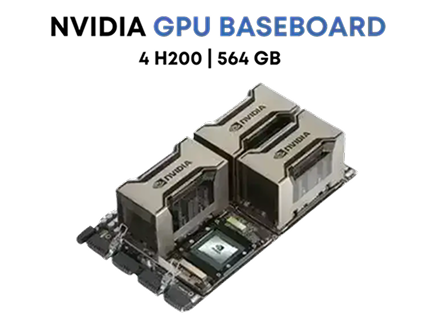
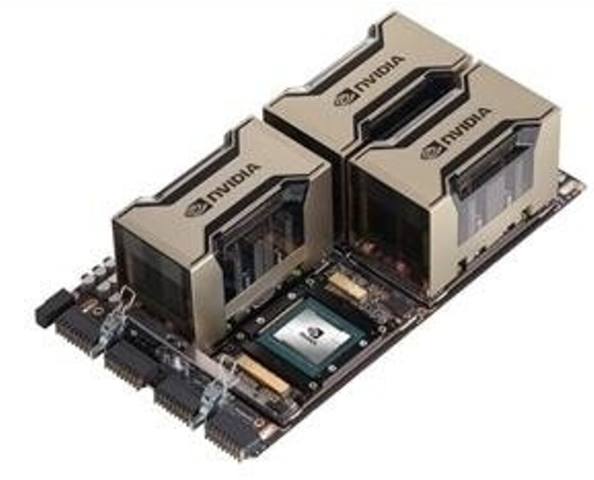
NVIDIA GPU Baseboard 4 H200
SKU: G593-ZD1- AAX3
Get this product for
$249,900
☆
4.8
$5446,000.00
Key features
- Graphics Engine: H200
- BUS: NVIDIA NVLink
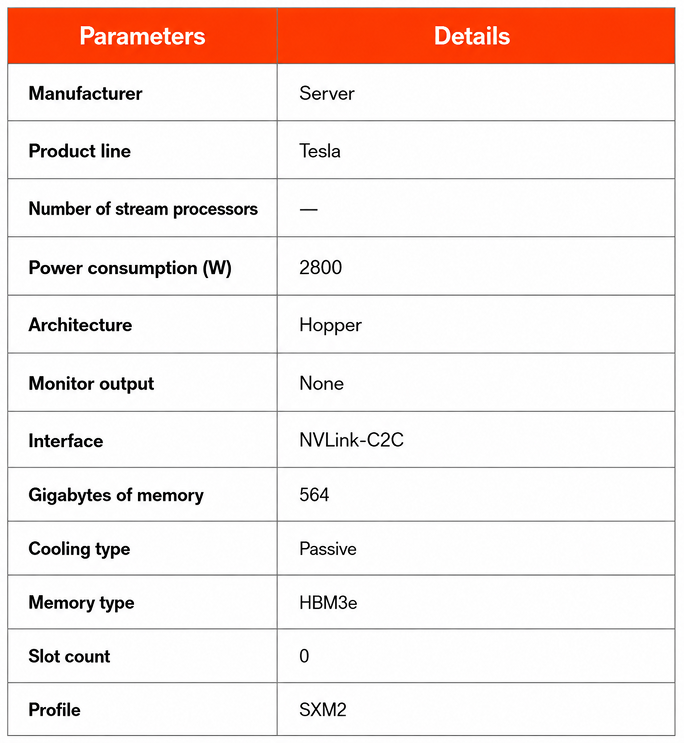
- Memory size: 564 GB
- Memory type: HBM3e
- Theoretical performance: 268 TFLOP
NVIDIA GPU Baseboard 4 H200
NVIDIA Server
NVIDIA’s products present a range of professional graphics cards designed for both rackmount
servers and powerful workstations. These are very high quality graphic products with large memory
and a special set of drivers that are adapted to work in CAD and other professional applications as well as remote collaboration,
virtual desktop, 3D visualization and rendering, but also for machine learning. Compared to desktop graphics cards, they are often also optimized for lower consumption.
Theoretical Performance: 268 TFLOPS
Graphics Engine: H200
- VRAM, these days primarily of GDDR type, is a synchronous memory, similar to standard RAM.
- However, in the case of graphic memory, memory chips with
- faster throughput and multiple data transfer rates are concerned. The result is a much faster
- buffering of data that the graphics card or coprocessor calculates and passes to the processor.
- Memory size
- 564
- Memory type
- HBM3e

CUDA Technology
- Users of professional applications can benefit from CUDA graphics stream processors thanks to CUDA architecture.
- Thanks to this, the raw power of the graphics card can be used for specific calculations, which can accelerate the work manifold compared to a classic processor, which is significantly limited by a lower amount of cores.
Passive
- Passively cooled graphics cards do not have any powered moving components. They take advantage of optimized airflow, especially in a server environment,
which takes heat away from the graphics unit outside of the case. Passive cooling is used especially for very powerful graphics coprocessors.
PCI Express BUSNVIDIA NVLink
- PCI Express is an interface that usually takes the form of an expansion slot to ensure the modularity of the entire system, whether it is GPU, network cards, controllers,
M.2 drives or other expansion cards. It is true that the newer the generation and wider the interface, the higher the performance and throughput. Most modern graphics cards use 16 lanes to connect with the processor. Currently, the most up-to-date generation is PCI Express generation 4.0 with a speed of 2 Gb/s per lane.
Related Products.
Lorem Ipsum is simply dummy text of the printing and typesetting industry. Lorem Ipsum has been the industry’s standard dummy text ever since the 1500s.